
Blog
5 Best Restaurant POS Platforms for Takeout and Delivery
 August 31, 2026
 Share
Share
5 Best Restaurant POS Platforms for Takeout and Delivery
Most restaurants don’t lose money on bad food. They lose it on slow systems, clunky order flows, and payment processing fees that quietly eat into already thin margins. The best restaurant POS platforms fix exactly that, yet picking the wrong one creates new headaches, like dropped delivery app orders during Friday dinner rush or a system that crashes when table turnover is at its peak. After reviewing dozens of options across what customers report, feature depth, and real-world performance, this guide covers five platforms worth considering.
How the picks were chosen: Public information drove every selection here, including user reviews, feature breakdowns, ratings from software directories, and details pulled directly from official websites. Only platforms with a demonstrated record in restaurant technology made the cut.
Featured Platforms at a Glance:
- Orders.co — Best for restaurant POS and sales growth
- Shift 4 — Best for restaurant POS and payment processing
- Toast — Best for restaurant point of sale and management
- Loyverse — Best for small to medium-sized restaurants, cafes, and multi-location food service businesses
- Clover — Best for restaurant point-of-sale and payment processing
Why Restaurant POS Platforms Are Worth the Investment
Picking the right POS system isn’t just a tech decision. It directly shapes how fast orders move, how reliably payments process, and whether your kitchen team actually knows what’s coming out of the queue next.
The pressure during peak hours is real. A system that slows down when order volume spikes doesn’t just frustrate staff. It pushes customers out the door and kills table turnover rates at exactly the wrong moment.
Connecting a POS to third-party delivery apps like DoorDash and Uber Eats adds another layer of difficulty. Without clean connections, orders fall through the gaps, get entered twice, or show wrong item availability.
The right platform closes those gaps. It keeps average transaction processing time tight, maintains consistent system reliability even during the busiest shifts, and gives operators better control over payment processing fees per transaction.
Restaurant POS Platforms Comparison Table
Note: All data in this table is sourced from review platforms and the official websites of the listed companies.
| Company Name | Headquartered In |
|---|---|
| Orders.co | Los Angeles, CA |
| Shift 4 | – |
| Toast | Boston, Massachusetts |
| Loyverse | – |
| Clover | Sunnyvale, California |
1. Orders.co – Best POS for Unified Dine-In and Takeout Order Management
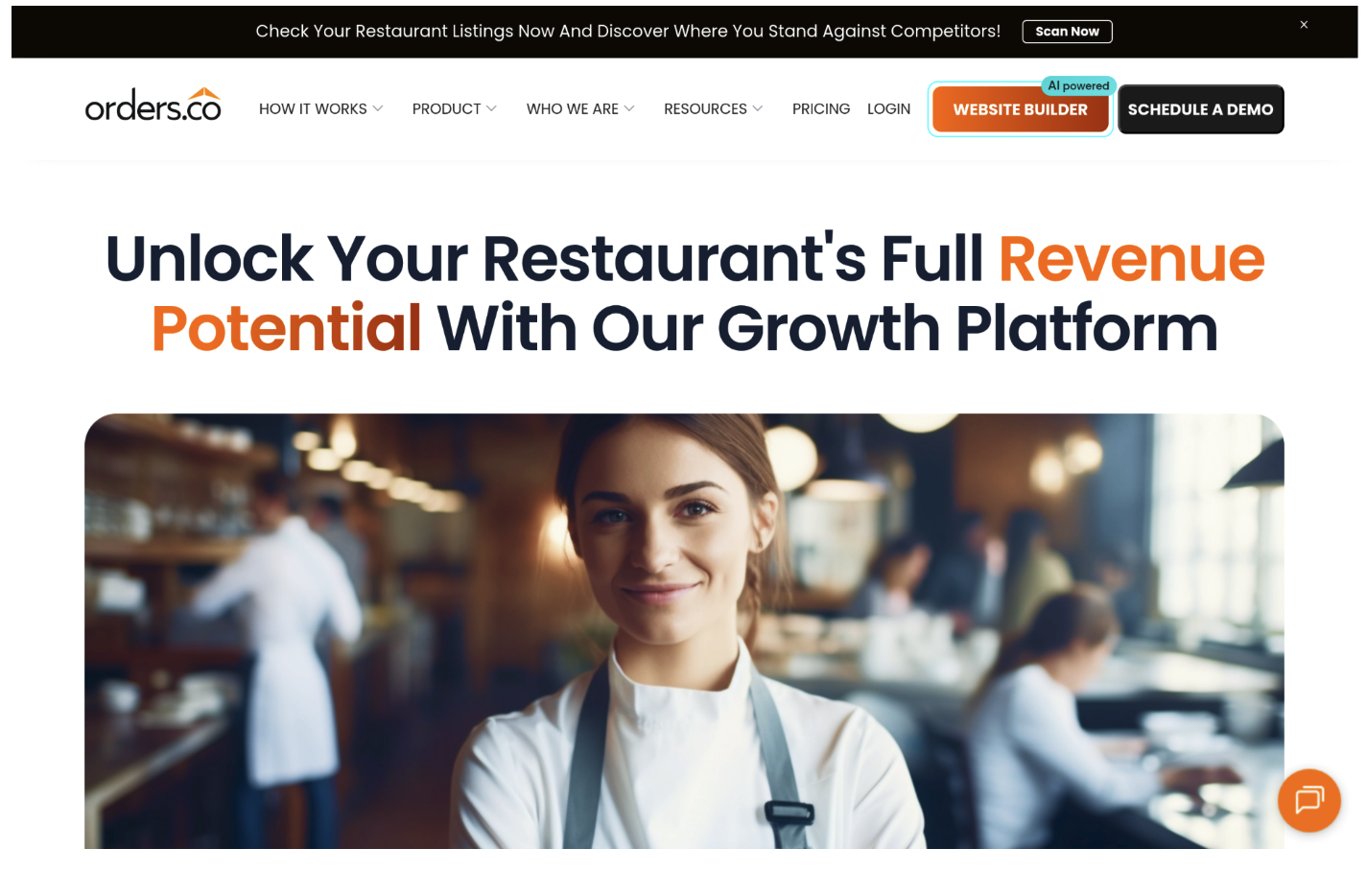
[Screenshot: Orders.co Interface & Website]
Where Does Orders.co Operate and What Is Its Purpose?
Orders.co is a cloud-based restaurant POS out of Los Angeles, built around a problem most systems handle only halfway: dine-in and takeout running on separate rails. Here they run on one. A table-side order from table nine, a phone order for pickup, a direct website order, and marketplace tickets from ezCater, UberEats, Grubhub, and DoorDash all queue in the same place, route to the same kitchen display, and report against the same numbers at close. At 7 pm on a Friday, that’s the difference between one screen and a shelf of tablets each chirping at a different volume. The platform brings:
- Table-side Dine-In Express ordering and KDS: table-side ordering that feeds the same kitchen queue as everything else, without requiring a separate payment-enabled device or workflow.
- Order consolidation across every channel: marketplace, direct, phone, and dine-in in a single view.
- Menu sync that runs in real time: one change reaches everywhere, so a sold-out item is marked as unavailable across all four apps at once instead of continuing to generate orders and refund requests.
- A commission-free ordering website: included with the account, so takeout volume can shift toward a channel the restaurant owns rather than rents.
- Delivery dispatch on flexible terms: assign and route deliveries the way the operation actually works.
- Loyalty plus automated marketing: behavior-driven campaigns that keep running without anyone assigned to manage them.
- Fast dispute management: 3rd-party app chargebacks and disputed delivery orders get worked rather than written off, which is where margin leaks on high-volume takeout.
- A catering module: its own ordering flows and dispatch.
- X and Z shift reports: top seller data, and provider-level performance—one set of numbers covering the dining room and the pickup counter, plus a clear read on which delivery partner is actually earning its commission.
What’s Orders.co’s Edge in Restaurant POS Platforms?
Plenty of systems in this space started as retail software and had restaurant logic layered on afterward, which surfaces the moment a nested modifier or a dining-room loyalty rule needs to work correctly. Orders.co began in hospitality, so it handles those from the first shift. Three things separate it:
- Live phone support, 24 hours a day, every day: someone answers, which is what you want when orders stop flowing mid-rush and a ticket queue with a next-business-day reply is useless.
- The commission-free ordering website ships with the account: it isn’t a paid add-on, so direct orders stay direct, and that margin stays in the restaurant.
- Four subscriptions become one: third-party marketplace aggregation, loyalty, hybrid delivery dispatch, and inventory management all consolidate into a single platform, reducing the number of separate tools restaurants need to manage.
2. Shift 4 – Best for Restaurant POS and Payment Processing
Where Does Shift 4 Operate and What Is Its Purpose?
Shift 4 Dine brings POS software, hardware, and payment processing together under one roof. The parent company, Shift 4 (NYSE: FOUR), has 25+ years of processing over $260 billion annually for more than 200,000 customers. Their restaurant-specific setup covers command center terminals, mobile terminals, kitchen display systems, and self-service kiosks. A nationwide network of certified technicians handles onsite installation and service, and every deployment is backed by a lifetime warranty on all hardware with free replacement.
What’s Shift 4’s Edge in Restaurant POS Platforms?
One of the most persistent problems in restaurant tech is finding a single vendor that handles hardware, software, and payment processing without forcing operators to manage three separate relationships. Shift 4 solves that. Their transparent pricing starts at $29.99 per month per workstation with software updates included, so the cost structure doesn’t catch operators off guard six months in.
3. Toast – Best for Restaurant Point of Sale and Management
Where Does Toast Operate and What Is Its Purpose?
Toast is a Boston-based restaurant management platform built entirely on Android, serving roughly 120,000 US restaurants as of mid-2024. Their system covers POS, online ordering, email marketing, inventory management, reservations, payroll, and scheduling, with 200+ integrations connecting to the broader restaurant tech stack. One standout piece of hardware is the Toast Router, which includes built-in cellular service and automated backup to keep operations running during internet outages. The company went public in September 2021 in one of that year’s largest American IPOs.
What’s Toast’s Edge in Restaurant POS Platforms?
Toast focuses exclusively on restaurants, which means every feature, every update, and every connection decision gets made with food service operations in mind (not retail, not healthcare, just restaurants). That single-sector focus translates to a platform that handles the full scope of restaurant management without requiring operators to work around features that were never designed for their context.
4. Loyverse – Best for Small to Medium-Sized Restaurants, Cafes, and Multi-Location Food Service Businesses
Where Does Loyverse Operate and What Is Its Purpose?
Loyverse turns smartphones and tablets into full POS systems, serving over one million businesses across 170 countries in 25+ languages. The platform covers sales processing, inventory management, employee management, sales analytics, customer loyalty programs, and multi-store management, all from a mobile-first design that works offline when connectivity drops. Support for 30+ country payment processors makes it a practical option for restaurants operating across different markets, and the core POS app is free (which is a rare thing in this space).
What’s Loyverse’s Edge in Restaurant POS Platforms?
Loyverse solves the affordability problem for small restaurants and cafes that need capable POS technology without the enterprise price tag that comes with most full-featured systems. The team’s 20+ years of POS software development experience shows up in the product’s stability and the depth of its loyalty program features, which go well beyond what most free tools offer.
5. Clover – Best for Restaurant Point-of-Sale and Payment Processing
Where Does Clover Operate and What Is Its Purpose?
Clover is a Sunnyvale-based cloud POS platform launched in 2012 and now owned by Fiserv, the world’s largest merchant acquirer. The system processes over 2 billion transactions annually in the US alone, running on affordable Android hardware including the Clover Station, Mobile, and Mini. Restaurants can configure the platform for both counter service and table service models, and an open App Marketplace lets operators add third-party tools without being locked into a single vendor’s ecosystem.
What’s Clover’s Edge in Restaurant POS Platforms?
Clover addresses the scalability question that growing restaurant groups face, which is finding a POS backed by enterprise-level infrastructure that still works for a single-location cafe (not cheap, but worth it for operators planning to expand). Fiserv’s backing gives Clover a level of financial stability and merchant processing depth that most standalone POS providers can’t match.
Selection Framework: How Each Pick Was Evaluated
The research behind this list started broad and got progressively tighter as each candidate was measured against a consistent set of criteria.
Baseline Information Compilation
Building the initial list meant pulling from multiple directions at once. Software directories, user review platforms, restaurant industry publications, and direct website research all contributed to the starting pool of candidates. The goal at this stage was coverage, not filtering. Any platform with meaningful presence in the restaurant POS space got added to the longlist regardless of size, pricing tier, or target restaurant type.
Filtering Candidates Down to Finalists
Once the longlist was assembled, each candidate went through a tighter pass. Options with thin or unverifiable review histories were removed first. Then patterns in what customers reported were analyzed across multiple platforms to identify which systems consistently delivered on their main promises. Platforms where review sentiment was overwhelmingly negative or where feedback patterns suggested reliability issues didn’t advance. The finalists were the systems where evidence pointed consistently in a positive direction across multiple independent sources.
Claims Undergo Fact-Checking Review
Every claim found on official websites was cross-referenced against what actual users reported in reviews and case studies. When a platform advertised a specific capability, like clean delivery app connectivity or offline transaction reliability, the review record was checked to see whether real-world experiences matched. Where gaps appeared between what a platform claimed and what users actually experienced, those inconsistencies were factored into the final evaluation.
Industry Standing Check
Beyond user reviews, each platform’s broader reputation was assessed. Awards from recognized industry bodies, mentions in restaurant technology publications, and evidence of original research or product development specific to food service were all considered. Platforms that appeared frequently in credible third-party coverage and had collected meaningful recognition from industry organizations ranked more favorably here. This step helped separate platforms with genuine standing from those with polished marketing but thin external validation.
Real-World Restaurant POS Platforms Evidence
The final check focused on restaurant relevance. Platforms were evaluated on whether they maintained dedicated feature sets for restaurant operations, whether verified reviews came from actual food service operators, and whether any available case studies reflected real outcomes in restaurant environments. Systems that could only show generic business results rather than restaurant-specific performance evidence were weighted lower. The platforms that made the final list all showed clear, documented relevance to the restaurant technology space through their feature pages, their customer base, and the detail of their user feedback.
Choosing the Right Restaurant POS Platforms: A Quick Guide
No single platform works perfectly for every restaurant, so the right choice comes down to matching what a system actually does well to what your operation actually needs. Here are five areas worth evaluating before committing:
- Industry and Domain Experience: Look for platforms built specifically for restaurants, not adapted from retail or generic commerce tools. Restaurant workflows, kitchen display routing, and delivery connections require purpose-built thinking.
- Features and Services: Map the platform’s feature set against your actual operation. Online ordering, loyalty programs, inventory tracking, and payroll all under one system reduces the number of vendors you’re managing simultaneously.
- Pricing Structure: Monthly software costs, payment processing fee percentages per transaction, and hardware costs all add up. Ask about total cost of ownership across a 12-month period, not just the monthly subscription rate.
- Results Measurement: A good platform gives operators clear visibility into transaction processing times, table turnover rates, and inventory shrinkage. If the reporting tools are weak, it’s hard to know whether the system is actually helping.
- Industry Knowledge and Compliance: Confirm the platform handles PCI DSS compliance, EMV chip standards, and any local tax requirements relevant to your market. These aren’t optional, and gaps here create real operational risk.
Wrapping Up
Choosing among the best restaurant POS platforms comes down to matching real operational needs against what each system genuinely delivers. Shift 4 and Clover bring serious payment infrastructure. Toast leads on restaurant-specific depth and market presence. Loyverse makes professional POS accessible without a big budget. Orders.co stands apart by connecting online ordering to automated sales growth. As delivery volumes keep climbing and restaurant margins stay tight, the right platform becomes less of a tech choice and more of a business foundation.
Related Post
The Best Professional Thermometers for Independent Restaurants
Picking a professional, restaurant-grade thermometer can be overwhelming. Dozens of models,
Read More
Download the App for Free and Discover How Effortless Team Management Can Be


